Understanding mowing costs in Turfgrass Production
Mowing is one of the highest recurring costs in professional turfgrass production. For a producer mowing 70 hectares 80 times a year, total mowing costs can easily exceed EUR 75,000 annually. Yet many operations have never broken down what a single hectare of mowing actually costs.
Cost components
Mowing cost per hectare has five components.
Labour is typically the largest single cost. An efficiency factor of 1.3 accounts for non-mowing time: transport between fields, refuelling and minor maintenance.
Tractor cost covers depreciation, maintenance, insurance and interest on the tractor itself. A figure of EUR 40 per hour excluding fuel is used as default.
Fuel cost depends on two things: the litres consumed per hectare and the diesel price. These vary significantly between mowing systems.
Maintenance differs by mower type. Rotary mowers require mainly blade replacement at around EUR 0.50 per hectare. Cylinder mowers need regular precision grinding of each reel, at roughly EUR 1,000 per reel per year.
Ownership covers depreciation and interest on the mower itself, calculated over a 12-year economic life with a 10% residual value at 5% interest. This is a fixed annual cost regardless of how many hectares you mow.
In most operations, labour and tractor together account for 50 to 70% of total mowing cost. The mower itself is a smaller share. That means anything reducing mowing hours has a disproportionately large effect on total cost.
Speed section
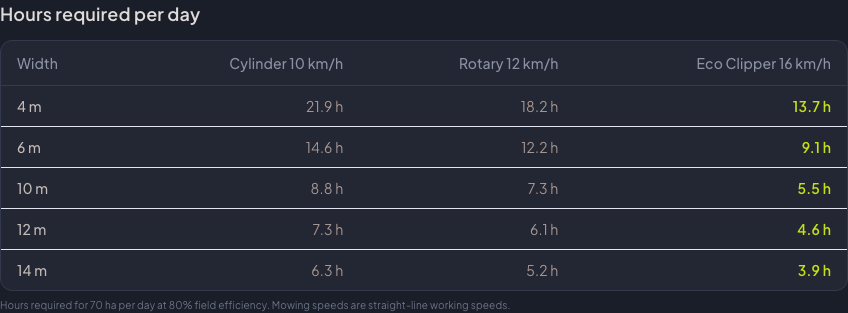
Mowing capacity determines how many hours you need to cover your daily area, and therefore how much you spend per year. The formula is straightforward:
Capacity (ha/h) = working width (m) x mowing speed (km/h) x 0.80 / 10
The factor 0.80 represents field efficiency: time lost at headlands, turning and overlapping.
Cylinder mowers and rotary roller mowers are supported by rollers. Above roughly 10 to 12 km/h, the rollers cause the machine to bounce, creating a washboard pattern in the sward. This is a physical constraint, not a machine deficiency.
Conventional rotary mowers run on wheels, removing this constraint. Practical working speeds of around 12 km/h are achievable.
Eco Clipper mowers are wheel-supported with an optimised deck design and kinematic suspension, enabling working speeds of 16 up to 20 km/h under standard turfgrass conditions.
At any given working width, Eco Clipper requires around 25% fewer hours than a conventional rotary mower and around 37% fewer than a cylinder mower. Because labour and tractor costs are both time-based, this difference flows directly into the annual cost comparison.